

You are here Home » International Cooperation » International Projects
International Projects
EU funds and project cooperation
Institute for Public Administration Prague has a long term experience with the realization of international projects co-financed with EU funds. Currently the Institute participates on the project focused on the public administration reform in Georgia.
International project (2014 - )
"Support of Reform of Public Administration in Georgia"
In 2014 the Institute launched in the cooperation with Czech Development Agency its participation on the project “Support of Reform of Public Administration in Georgia“. It is the complex project, which other subjects mainly from academic sphere take part on.
In December 2014 a first study visit of Georgian colleagues to the Czech Republic, which was focused on the public adminstration and training of public administration of officials, took place. The delegation comprised the senior representative of Ministry of Regional Development and Infrastructure, top management of training centre CEGSTAR and the representative of the Office of Government of Georgia. The set of lectures involved the introduction of of the Czech public administration system , role of the Institute and principles of offcials training, issues of control or ethics in public administration, utilization of human resources and other related topics. Beside the lectures participants visited the Senate and Chamber of Deputies of the Parliament as well as the training center of the Institute in Benešov.
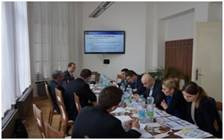
The second study visit to the Czech Republic with the participation of representatives from the Georgian Ministry of Finance was held in May 2015. It was focused on public finances and fiscal decentralization. The participants attended the session at the Ministry of Finance that was dealing with on the budgetary process or financing of municipalities and regions, one lecture was held at Ministry of Interior. The part of the programme was a visit of the Senate matched with the business lunch with senators from the Committee on Public Administration, Regional Development and the Environment or the meeting with representatives of Benešov municipal authority and the visit of the Institute’s training center in Benešov.
The third study visit was held in December 2016 and was aimed at quality training in public administration. Representatives of training institutions participated on a series of lectures focused on accreditation of training programme from various perspectives, issue of assessment of quality of training programmes, training institutions or quality of lectures. Moreover, the programme was amended by lectures on the system of public administration in the Czech Republic or on the current state of eGovernment. Participant also had the opportunity to visit Regional Authority of Central Bohemian Region, Office of Government of the Czech Republic, Municipal Authority in Mnichovice or Training Centre of Institute for Public Administration Prague in Benešov.
For the upcoming period there is intended the phase of eLearning implementation in Georgia.
International project (2011-2013)
"Sharing Best Practices in Introducing and Teaching Ethics Principles to Public Administration Employees"
Institute for Public Administration Prague in cooperation with foreign partners decided to realize the project focused on the issue of ethics in public administration, mainly on the current legal organization and opportunities to train public administration employees in this branch.
The project is designed for 2 years and is realized under Lifelong Learning Programme, within Partnership Projects of Leonardo da Vinci. The Institute acts as the coordinator in this project, other members of the project team are German Hochschule für Wirtschaft und Recht Berlin, Polish Krajowa Szkola Administracji Publicznej and Portuguese Instituto Nacional de Administracao.
Through regular meetings in partner countries the comparative study, which is to be composed from several chapters, will be gradually developed. It will focus on a brief introduction of the public administration system in respective countries and on training in public administration in general. Furthermore, it will provide a more detailed overview and comparison in the area of training of public administration officials in ethics, it will analyze the definition of ethical principles and the project will also focus on the current content and legal form as well as comparison of ethics codes.
The conclusion of the project will not be just a comparison, but the project also aims to utilize the good practice of respective countries and come with a proposal of an ideal form of this issue.
- Research study to download
- Meeting December 2011
- Meeting March 2012
- Meeting June 2012
- Meeting October 2012
- Meeting November 2012
- Meeting February 2013
- Meeting March 2013
- Meeting June 2013
International project (2009-2011)
"Transfer of Innovations in Methodologies for European Officials – Follow up a Joint Learning Path" (www.europeanofficial.eu)

The key project, which the Institute has recently participated on, held the title „Transfer of Innovations in Methodologies for European Officials – Follow up a Joint Learning Path“ and has been realized in Lifelong Learning Programme/ Leonardo da Vinci where it has belonged under Multilateral Projects/ Transfer of Innovation. This project was a continuation of the previously realized international project „Identifying and Validating of Competences of European Officials“ which was realized during 2005-2007.
The Institute submitted and coordinated the whole project and members of the project team were organization from Portugal (Instituto National de Administraçao), Italy (Scuola Superiore dell’Amministrazione delľInterno) and Bulgaria (Institute of Public Administration). The Slovakian Institute of Public Administration was also involved in the initial project‘s phase. The project has been realized since October 2009 until March 2011 and the contribution EU funds co-financincing reached 75%.
The project was focused on training of officials of EU member states – mainly ministerial officials and officials in self-governing territorial units. Its main objective was the creation of five training modules. These training modules were created in face to face as well as eLearning form. Modules are focused on following topics :
- Free movement of persons (Schengen issue)
- International protection in EU (development of right of asylum)
- Basic elements of managing social crises
- Integration of migrant women and children
- Active inclusion of migrants-women
In each country pilot courses for all five modules in a face to face form were realized and these were followed by pilot editions of eLearning modules. All outputs, i.e training modules in face to face and eLearning form, were created in English and all languages of participating countries.
The main objective of the project was to broaden and increase knowledge, skills and competences of European officials. Based on obtained competences the officials can better deal with situations and be well informed.
Czech and English version of products are available on CDs (further information will be provided by Mr.Lukas Jirsa at l.jir@institutpraha.cz or telephone +420 974 863 525). Products are also free to download at the official project’s website www.europeanofficial.eu
Brief description of training modules
Free movement of persons (Schengen issue)
The training module Protection of Borders in Schengen Area deals with issue of Schengen with a focus on a restoration of border controls. Thus, participants should receive not only general information but also information of legislative and practical aspects of Schengen acquis. The module involves topics of national and European legislation related with free movement of persons, practical aspects of borders protection, discussion and practical case studies focusing on a restoration of border controls and police and judicial cooperation.
International Protection in EU: Current Development of Right of Asylum
The aim of the training module is to acquaint participants with the overview of possibilities within EU and share common interpretations how to implement such principles. The legislative framework of right of asylum, overview of common standards and their implementation, acquaintance with basic principles of international protection a general overview of geopolitical asylum context. The national insight presenting main actors, legislation and procedures is also involved as well as presentations, case studies, discussions etc.
Basic elements for Managing European Social Crisis with Transnational Impact
Participants will receive general information for a better understanding of the given area and they will be provided with tools for better data and information analysis/utilization within the crisis management. They will be able to identify and recognize criteria in social crisis management within EU and identify needs and sources of EU. The main topic are European institutions, legislative framework related to crisis management, main actors involved to solving social crises, European social crisis – main signs, where and how it can start, who are the main actors, why and how it develops etc. The national lesson focused specifically on the Czech Republic is also involved. The training module contains case studies, presentations etc.
Integration of Migrant Women and Children
This module is dedicated for officials, who have already encountered the integration of the integration or have marginally touched the issue. The purpose is to recap the overview of the current immigration situation of women and children within EU and the Czech Republic and to raise awareness about cultural differences and the necessity to prevent stereotypes and discrimination in relation with the declaration of human rights. Participants should be able to identify main actors, apply suitable measures and tools available within EU and the Czech Republic. The module involves case studies and other participative methods.
Active inclusion (focused on migrants)
Participants should receive general knowledge of the protection within EU and the proces sof social inclusion. On a national and international level they will be acquainted with three pillars of active inclusion within the still developing strategy. After passing the module the participants should be able to identify good practice within the active inclusion, to be able to cooperate with institutions dealing with the inclusion, evaluace projects focused on active inclusion or to plan and propose them. Beside presentations made by the lecturer, the methods of group learning, case studies and discussions are used.